An Unofficial Brief History of Director
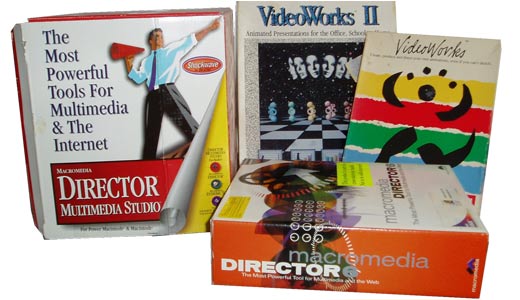 Packaging from the glory days (pre-ESD)
The Videoworks Years (1984–1988)

Jay Fenton, Marc Canter and Mark Pierce had worked together at Bally Games in Chicago. In the spring of 1984 Marc got angel funding from his father-in-law and together they formed a company called MacroMind. As Marc puts it, MacroMind was "a software rock and roll band; a programmer, an artist and Marc, the musician and manager". This rock and roll band released a programme in 1985 called VideoWorks and in 1986, signed a licensing deal with Apple to put an "interactive guided tour" disc created with the VideoWorks run-time player into every Macintosh shipped.
VideoWorks required a "Macintosh with at least 128k" and "although VideoWorks will work satisfactorily with just the Macintosh's internal drive, a second (external) drive will help avoid a lot of disc swapping". VideoWorks also included some fantastic 1-bit 'canned artwork' by Marc Pierce and Mike Saenz, including walk cycles, city scape and (my favourite) a jumping mushroom. VideoWorks 'program design' is credited with Marc Canter, Jay Fenton and Mark Pierce and 'programming' credited to Jay and Dan Sadowski.
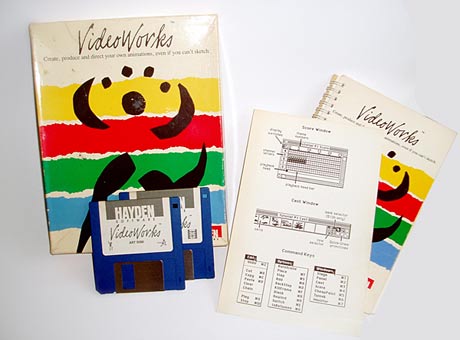 Videoworks box and disks
In 1987, when the first colour Macs started shipping (and hard drives were more common), Macromind released VideoWorks II (with colour!). VideoWorks developed into "VideoWorks Interactive" which had a language modelled after Basic. Although it never got out of "beta" status, it was licenced to various people, including Apple which continued to use it for their "Guided Tours" which were installed on all Macs that were sold. In 1987, Macromedia created the 2nd-ever Mac CD-ROM with VideoWorks animations (Apple had done the first).
Like all rock and roll bands (except perhaps the Rolling Stones), the MacroMind software rock and roll band broke up. Mark Pierce was gone within a year (he went on to do the legendary Macintosh game Dark Castle, released in 1986). Jay stayed on for almost two years before joining Alan Kay to work on an Apple-funded education research project called Vivarium. As Roger Jones puts it:
There was a lot of energy in the early days. Marc, despite his peccadilloes, had the ability to inspire us and instill a sense that what we were doing was ground breaking work, we were changing the world. The command hierarchy was pretty flat, we were all in it together... The office at 410 Townsend was one big room where everyone worked elbow to elbow on vinyl topped bingo tables laid end to end. I think the space had been a garment factory before MM. We rode up to the office in a scary freight elevator that made loud banging noises on the occasions when it functioned. But despite the oppressive conditions those 40 hours days seemed to fly by. It was always fun to go to work.
Macromind Director (1988–1992)
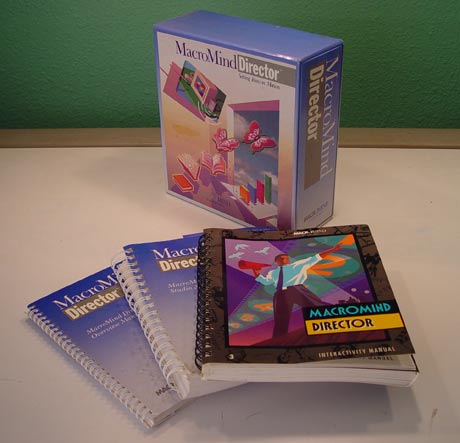 Macromind Director box and manuals
In 1988, 'VideoWorks Interactive Pro' becomes Director 1.0. John (JT) Thompson and Erik Neumann replaced the original Tiny Basic scripting language by Jamie Fenton with the Lingo Scripting engine. With the release of Director 2.0 (1990), JT said:
At that point I was researching object orientness in general - SmallTalk, Objective C - and I had background in LISP in terms of the kind of things that you can do interpretively, encapsulate data, recursion, that kind of stuff. So those ideas got synthesized into Lingo and XObjects.
Around this period, Videoworks/Director was being used to create the computer graphic displays for Star Trek: The Next Generation, and the 'multimedia' boom was just about to take off.
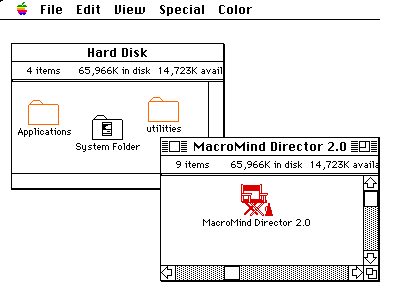 Director 2
 Director 2 Cast
In 1991 (or 92), Director 3 was released. Although Director 3.0 was still a Mac-only authoring environment, Macintosh Director movie files could be converted (using "Gaffer") for playback on Windows 3.1 with "DFW" (Director for Windows). There were also players for other operating systems such as:
- OS/2 (a joint project with IBM who sent a group of engineers to MACR to work on it)
- Personal IRIS
- FM Towns
- 3DO player
- OS9 David player (early set top box OS)
With the upgrade to version 3.1.3 (1993) — arguably Director's most stable release ever — Macromind Director became "Macromedia Director" and gained support for a new and exciting technology from Apple called QuickTime.
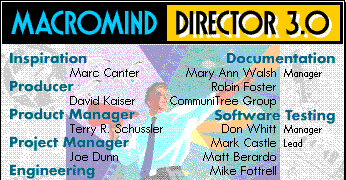 Director 3 About Box
A Near Death Experience
The original Windows player port of Director was done by an outside company and "was buggy as hell". It languished for months in QA and seemed to have stalled. This was in 1988–89, in the days of Win 3.0 and WFWG. Finally two programmers were brought in-house to get things moving: David Jennings and Greggy Yachuk. They squashed hundreds of bugs and were able to get the product into a shippable state. Meanwhile, Macromind founder Marc Canter was deposed, and new management came in just prior to Director 3.0 being shipped.
The new CEO called a company meeting and announced that 3.0 was the final version of Director and the company was dropping Mac development (because "Mac was dead") and shifting focus to Windows business presentation tools (Action!). Prevailing logic at the time was that Director was hopelessly Mac-centric and the DPW experience suggested that it would be impossible to port to Windows. Bolstered by his success with DPW, David Jennings went to management and against all odds convinced them that it was possible to put Director on Windows — effectively saving Director from its near death experience.
 Director 4 Icons
In 1992, Wolfenstein 3D was released. But this significant event was soon overshadowed by the release of Director 4.0 at the start of 1994. For the first time the authoring environment and files were cross-platform (Mac and Windows). Lingo was vastly improved and now featured lists and parent scripts (as a replacement for "factories"). XObjs and XCMDs provided further extensions. Updates to Director 4 included:
- D4.01 — the PowerMac update (late April)
- D4.03 — Win-only (August) and the first Director Authoring version to run under Windows
- D4.04 — unifying release and the last floppy release (18 floppies!)
The "multimedia" hype was now in full swing. Myst was a big seller and 'multimedia CD-ROMs' were selling in shops. Bill Gates announced the licensing of the Director player.
Shockwave Arrives
In April 1995, Marc Canter made the prophetic observation that as broadband infrastructure got put in place:
It becomes increasingly more apparent that CD-ROM is not the only form for delivery for multimedia content. Various forms of broadband distribution will come into place throughout the world this century, and Director will form a bridge across these platforms to guarantee compatibility and scalability of your creative work.
In December 1995, Shockwave appeared for the first time when Macromedia made the "first public demonstration of technology that allows computer users to run video movies created using its Director animation program without the jerkiness typically associated with computer video". Shockwave files were made with a programme called "Afterburner".

Director 5 (1996) introduced MOA and Xtras, as well as new features such as the debugger, watcher and multiple casts (previously, all movies had a single internal cast — assets were shared using a special movie called SHARED.DIR). There were a significant number of new Lingo commands and constructs (such as case statements).
Meanwhile, a company called FutureWave had developed a drawing application called "SmartSketch" for use on pen computers. This programme developed into "FutureSplash Animator", a vector-based animation programme designed for the Internet. This software had been offered to Adobe and Fractal Design without success, but eventually Macromedia purchased the company. In 1996, Flash 1.0 was released.

Director 6 (1997) — "The Director Multimedia Studio" — vastly improved the 'sprite' construct and introduced 'behaviours' and integrated Shockwave support (the Afterburner Xtra was no longer required). Director 6.5 was a much-anticipated update to fix problems caused by the release of QuickTime 3.

Director 7 (1998) was released as part of the "Shockwave Internet Studio" and was billed as having been "rebuilt from the ground up", the culmination of "five years of development". New features included RGB support, 1000 sprite channels, sprite rotation and skewing, embedded fonts and vector shapes. Director 7 also saw the introduction of dot syntax and the arrival of the Multiuser Server. As Buzz Kettles explained:
DPW (Director Player for Windows) was the original core code for all those 'other platform' playback engines (originally 'other' meant non-Mac). This playback-only code got fleshed out feature by feature until it was then used to build the Shockwave Player and then became a standalone playback engine that the Director Authoring UI could be grafted onto in order to create Director 7... So the so-called 'Director 7' rewrite actually began during Director 3.
Despite many new features, Director 7 was seen by some as a disappointment (bloated, buggy and slow compared to Director 6.5). About now, the 'multimedia' star began to dim as the Internet became the Next Big Thing. Flash, with its smaller ubiquitous plugin and cheaper authoring environment, seemed better suited to the Internet.
 Director 8 and 8.5
Director 8 (2000) was a marked improvement over version 7 — much more stable and reliable, with enhancements such as linked scripts, lockable sprites, guides, and imaging lingo. A new audio engine was introduced, though sounds would now stutter and stop more easily.
Director 8.5 was a significant update introducing Flash 5 compatibility and interactive 3D asset support. The Multiuser Server was upgraded to version 3.0.
 Director MX
Director MX (2002) (aka version 9) featured OS X compatibility, Flash 6 compatibility and some authoring enhancements. Around this time, Macromedia announced the end of the Multiuser Server and Multiuser Xtra.
Director MX 2004

Director MX 2004 (aka version 10) was released in early 2004. Notable new features included a JavaScript syntax as an alternative to Lingo and the introduction of a new Document Object Model (DOM).
The new DOM meant that most scripting functionality could now be accessed via 'Core objects' that include the Director player engine, movie windows, sprites, sounds, and so on. In the old days you might write:
if the name of member of sprite 1 = "foo" then go to the frame
Whereas in the new DOM model you would write:
if (_movie.sprite(1).member.name = "foo") then _movie.go(_movie.frame)
Adobe Director (2005–)
On 18 April 2005, Adobe announced that it had acquired Macromedia (at US$3.4 billion). The sale was completed in December 2005 and Director became Adobe Director.
On March 14, 2006, Shockwave Player 10.1.1r16 was released. The main feature of this free update was a new Flash 8 Asset Xtra allowing use of Flash 8 authored SWF assets.
Adobe Director 11
 Adobe Director 11
In late February 2008, Adobe released Director 11. The most significant change was that Director became Unicode compliant, requiring a significant rebuild with development moved to India where "40 engineers are actively working on Director".
Director 11 (and Shockwave 11) also became universal binaries on the Mac. This meant that non-Unicode-compliant Xtras and all Mac Xtras would no longer work correctly. A few popular Xtras — such as the OS Controls Xtra — announced they would not be updated.
Adobe Director 11.5
In March 2009, Adobe released Director 11.5, a vast improvement over Director 11. New features included:
- New sound engine with a new 'mixer' object and filters
- Streaming 5.1 audio
- New
byteArray member type and set of functions
- Fixes to the new text engine
Adobe Director 12
Director 12 was released February 11, 2013.
The End
January 27, 2017 — Adobe announced that it "will no longer be selling and supporting Adobe Director. Sale of Adobe Director will stop on February 1, 2017. We will also stop ongoing updates and support for Adobe Shockwave on Mac devices on March 14th after the last release of the product."
First published 21/03/2005